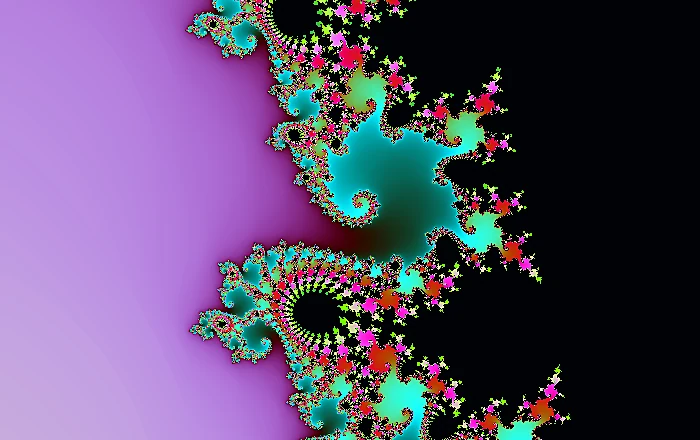
A rule that keeps making detail
A fractal is a shape, set, signal or process whose structure remains complicated as scale changes. Some mathematical fractals are exactly self-similar; others repeat only approximately or statistically. The key idea is that zooming does not simply make the object smooth and featureless.
Benoît Mandelbrot introduced the word fractal in 1975, helping unify older “pathological” mathematical objects with the study of roughness, scaling, branching and irregular natural forms.
Dimension can land between dimensions
Lines have ordinary dimension 1, planes 2 and solids 3. Fractal dimension can be non-integer and measures how detail or occupancy changes with scale. Hausdorff, box-counting and similarity dimensions are related but distinct tools.
| Object | Classic dimension | Meaning |
|---|---|---|
| Cantor set | log(2)/log(3) ≈ 0.6309 | Between isolated points and a full line. |
| Koch curve | log(4)/log(3) ≈ 1.2619 | More space-filling than a smooth curve. |
| Sierpiński triangle | log(3)/log(2) ≈ 1.5850 | Between line-like and plane-filling. |
| Sierpiński carpet | log(8)/log(3) ≈ 1.8928 | Nearly plane-filling but full of holes. |
| Menger sponge | log(20)/log(3) ≈ 2.7268 | Between surface-like and solid-like. |
| Mandelbrot boundary | Hausdorff dimension 2 | A boundary with the dimensional richness of the plane. |
Major families
Mandelbrot & Julia
Iterate complex equations and classify bounded versus escaping orbits.
OPEN →IFSRecursive transforms
Barnsley fern and Sierpiński systems emerge from repeated contractions.
OPEN →CHAOSStrange attractors
Deterministic systems can form non-repeating attractors with fractal structure.
OPEN →NATUREStatistical scaling
Coastlines, lungs, terrain and clouds can show scale-dependent fractal-like behavior.
OPEN →